

A New Progressive Era Is Emerging
The case that a bipartisan movement structured around driving great progress and reform may be reaching critical mass in America much like what happened in the early 20th century

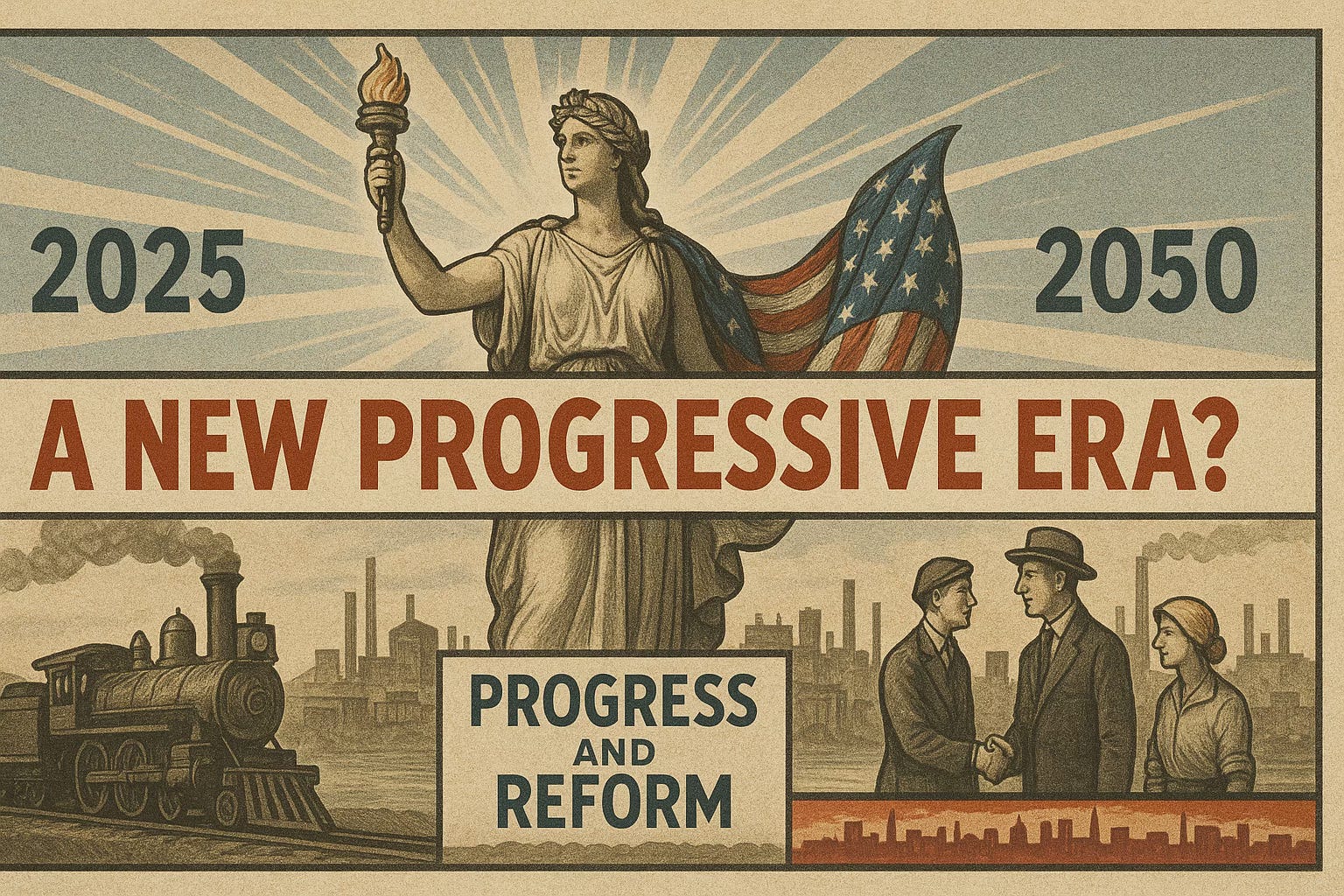
A wave of new general-purpose technologies transforming America. The entrepreneurs and investors behind the technologies capturing vast amounts of wealth. Tech titans exerting unprecedented power in politics amid the increasing corruption of government. The nation experiencing mounting income inequality and the rise of populists on the right and left.
Many might say that’s a good description of America today, but it could also describe the country in the late-19th century, sometime around 1895. That was the high point of what Americans still call “The Gilded Age of the Robber Barons,” industrialists who amassed spectacular fortunes around the general-purpose technologies of their time, including electricity. The most powerful of them, such as those who controlled the vast networks of railroads, also controlled many elected officials at all levels of government. This helped ensure they got what they wanted, even if it was against the interests of the masses, leading to the rise of angry movements on the right and left in the forms of rural prairie populists and urban socialists.
But America at the turn of the 20th century did not devolve into an authoritarian plutocracy as many feared. Nor did the populists on the right or left ever amass the power needed to transform America along the lines of their more extreme visions.
What actually happened? Intellectuals and educated professionals, upper-middle-class elites from both the Republican and Democratic parties, thinkers and doers from left-of-center and right-of-center on the political spectrum, ignited a reform movement that, over the next 25 years, transformed how America’s economy and society worked.
What started as an elite endeavor of big ideas quickly attracted broad-based support from the mainstream middle and working classes. With a roughly 60/40 majority, the coalition was able to drive many structural changes in America, including fundamental amendments to the U.S. Constitution.
We now call this period of great reform from 1895 to 1920 — a time that remade America in general and its urban areas in particular — The Progressive Era.
I think a strong case can be made that America today could be entering a similar era of structural reform and great progress — one that may be eventually seen as The 21st-century Progressive Era.
Despite widespread fears from left-of-center, America will not devolve into a right-wing autocracy controlled by a plutocracy of billionaires with a nod from the tech titans — even given MAGA and President Donald Trump’s authoritarian tendencies.
Despite widespread fears from the right-of-center, America won’t fall under the control of the far left, with old-school socialism and big government bureaucrats at the helm. That’s even more of a distant dream.
I think the most probable outcome of our current juncture will be the emergence of a new majority of smart, practical, common-sense Americans. They will embrace the realities of powerful new general-purpose technologies like artificial intelligence, while recognizing the need to restructure the economy and reform society to ensure the techs’ benefits are shared by all.
We’re still in the early stages, but a realignment within politics and the acceleration of great progress may well be in our near future.
An advance team of elites, what I call the A Team, is already on the case. They are figuring out how to make the most of these technologies and identifying the fundamental changes we might need to make in our economy and society to ensure they benefit the majority over the long run.
These elites come from both left-of-center and right-of-center in politics, and individually, they might identify as Republicans or Democrats when pressed. But they don’t embrace many of either party’s current mainstream positions because both parties seem stuck in old models from the past.
These elites have tech-positive, future-forward worldviews and can-do attitudes. They see the need for widespread innovation that goes beyond the technologies themselves. Much of their focus is on what reforms — if not full reinventions — need to happen to our economic and social systems. They see the need to overhaul governments at all levels through big policy changes, but their goal is to bolster state capacity to get more done, faster.
You can find members of the A Team gathered in think tanks, at conferences, and around publications that often use the key words “progress” or “abundance” — those that are more left-leaning seem to prefer ”abundance,” while those that are more right-leaning appear to favor ”progress.”
By any historical standard, these people and their movement would be considered “progressive.” Set aside the contemporary political definition of a progressive. That label is sometimes broadly applied to America’s entire Democratic Party, while other times it’s narrowly applied to those on the far left or who identify as socialists. Let go of those notions for a moment.
Throughout American history, the pendulum has always swung between two political mindsets and sets of values — one rises, while the other falls. More broadly, this same yin/yang pendulum swing occurs in all Western democracies and other societies, too.
Some periods are more conservative, as in they are about the root word “conserve.” These times can revitalize the nation — it returns to the best of the old ways and cautiously moves forward. These periods tend to benefit those already doing well in the status quo, particularly the rich.
Other periods are more progressive, as in they are about the core word “progress.” These times focus on innovation and bigger system changes in an attempt to accelerate progress. They tend to leave the status quo behind and benefit those who have more to gain, which usually means the middle and working classes or, in shorthand, “the people.”
I think a big-picture way to understand what’s happening in America right now is that we are on the cusp of a transition, leaving behind a conservative era that arguably started with President Ronald Reagan in 1981. Trump talks about being a conservative, but he’s really a right-wing populist taking advantage of the temporary period of breakdown between long-run eras.
Could we be entering a new progressive era that will play out over the next 25 years? It might seem implausible to most mainstream pundits, political insiders, and general observers who are stuck in the now. But that question would have been equally implausible to most Americans in 1895.
I’m going to make the case in this essay that we are heading into something similar to what happened in the original Progressive Era. The historical parallels are there. Very similar structural pressures are building. They had their breakthrough general-purpose technology that transformed America in the form of electricity — and we now have AI.
They started with their version of an A Team of elites coalescing around a common set of beliefs and coming up with big ideas about what to make happen in the decades ahead. Those early ideas quickly gained the support of an overwhelming 60/40 majority of the voting public, and America became a much better place for the majority of people in just 25 years.
Today, something similar is happening with an A Team of elites coalescing around a dozen common beliefs that I will lay out at the end of this piece. We’re still in the early stages, but a realignment within politics and the acceleration of great progress may well be in our near future.

What happened in the original Progressive Era — and why
In 1895, America had world-changing new general-purpose technologies, just like we do now. Over the second half of the 19th century, all-purpose steel, railroads, and telegraphs fused America into one nation that spanned the continent. As it headed into the 20th century, a new wave of similarly transformative technologies hit in the forms of new sources of energy, like oil, and new means of communication, like telephony.
The most transformative of all was electricity — it allowed cities to light up 24/7 and to build upward in towering buildings with elevators. America reconfigured physically into big cities and economically with assembly lines and the like.
The tech titans of the time — and the bankers and financiers who funded them — amassed unprecedented fortunes drawing off this integrated new national market that spanned the continent. Andrew Carnegie vertically integrated the steel industry that laid the railroad tracks and erected the beams that created skyscrapers. Thomas Edison and George Westinghouse battled for dominance of the new electric grid and lighting. John D. Rockefeller built a near-total monopoly on energy distribution, particularly oil. J. P. Morgan was the financier who played the role of venture capitalist of that time.
We remember those people because they had the wealth to create the stately mansions and civic monuments that people still gawk at today, and their legacies live on in philanthropies that still bear their names.
But at the time, they were known as the Robber Barons and despised by wide swaths of the public, who deeply resented the extreme wealth inequality that arose due to the era’s laissez-faire economics. While the 1% of that time lived like kings, the vast majority lived in squalor and many worked under dangerous conditions for long hours in factories.
These extreme inequalities in wealth led to equally extreme inequalities in power in the American republic. Those titans of industry bought up the media, in the form of urban newspapers, and had an outsized impact on elections, often exerting behind-the-scenes control of public officials, particularly at the state level.
By the 1890s, this status quo — along with financial panics and widespread unemployment — led to the rise of angry populist movements, most notably the prairie populists, embodied by Nebraskan William Jennings Bryan, who was the Democratic Party candidate for president three times.
Bryan then, and populists in general now, tend to be adept at critiquing the current system and the elites who benefit from it, but their solutions often look back on an idealized past, not toward the future.
In 1895, the forward-thinking ideas were coming from urban centers where educated middle-class professionals lived. These were the intellectuals, social scientists, journalists, and other reform-minded people who lived in the shadows of the titans and saw the need to tame the excesses of raw industrial capitalism and modernize both government and democracy itself.
This group included the Muckrakers, the investigative journalists of that time, some of whose names are still recognizable: Lincoln Steffens, Ida Tarbell, Upton Sinclair, and Jacob Riis. It also included public intellectuals like John Dewey, Jane Addams, Thorstein Veblen, and W. E. B. Du Bois, as well as legal thinkers like Louis Brandeis, who would go on to serve on the Supreme Court.
A key point is that progressives of that time emerged from both the Republican and Democratic parties. The progressive movement was bipartisan.
Still well-known Democratic progressives from that time included President Woodrow Wilson and Governor Al Smith of New York. Notable Republican progressives from that time included President Theodore Roosevelt, Wisconsin Governor and later U.S. Senator Robert La Follette, and California Governor and later U.S. Senator Hiram Johnson, who brought about the initiative, referendum, and recall system still used in the state today.
Roosevelt played a particularly critical role in the tipping point between the Gilded Age and the Progressive Era, which was largely unexpected.
President William McKinley, a conservative Republican, was elected in 1896. He was a classic Gilded Age Republican, a staunch advocate of protective tariffs, which made him beloved by industrialists but unpopular with farmers and consumers who paid higher prices.
McKinley’s vice president died in 1899, so he needed to find a replacement to join him for his re-election campaign. He and the establishment conservative Republicans decided to put New York Governor Teddy Roosevelt on the ticket as vice president, which, in those days, had very little power and influence. Roosevelt was known as a reformer shaking up New York state — the establishment wanted to sideline him, and also use him to attract the growing constituency of reform-minded voters.
The Republicans won the presidential election, but six months into his second term, McKinley was assassinated. The reformer Roosevelt took over, and the Progressive Era began in earnest.
The first decade of the 20th century saw a wave of reforms at the municipal, state, and national levels. Roosevelt busted up the monopolistic trusts and regulated the railroads by increasingly leveraging the interstate commerce clause in the Constitution. Bills like the Food and Drug Act were passed to deal with urban squalor and sanitation, and national parks were established for the first time to stop the expansion of mining and industrial production on pristine lands.
In the second decade of the 20th century, when Democrat Woodrow Wilson took over as president for two terms, the reforms kicked into high gear with constitutional amendments that authorized a federal income tax for the first time ever, granted women the right to vote, and required the direct election of U.S. senators, who, until this, were appointed by state legislators often controlled by political machines and the railroads.
By 1920, Americans were exhausted — they’d undergone two decades of widespread reforms, fought in World War I, and survived a global pandemic. The Progressive Era ended, leaving in its wake a very different — and arguably much better — America.

The many parallels between then and now
Much of what I laid out above has clear and even obvious parallels to today.
We have the arrival of general-purpose technologies that are going to change America — and the world — in fundamental ways. Artificial intelligence is in a league of its own, but like electricity, it will impact everything and fundamentally change how America works.
We also have the arrival of cheap clean energy technologies, which will shoulder an increasing share of the nation’s energy burden — and keep getting better and cheaper over time.
Like the Robber Barons of the Progressive Era, today’s tech entrepreneurs and financiers are well-known, and because they can use modern digital infrastructure to draw off global markets, they’re becoming even more fabulously wealthy than their predecessors. Their companies are now worth trillions of dollars, and the entrepreneurs themselves are worth many billions. In aggregate, they have more wealth than whole classes of Americans.
Using that great wealth, today’s tech titans and their companies have recently waded into politics to get what they want in legal — and quasi-legal — ways. Elon Musk alone spent almost $300 million on the 2024 election cycle to help elect Donald Trump and his allies — more than any other individual and dwarfing the effects of the average citizen pitching in 100 bucks or so.
The situation has become so extreme that angry populism has exploded on both the right and the left.
People in rural Red States and the white working class — rooted in the old manufacturing economy of the heartland — have turned to right-wing populism. Young people, people of color, and members of the lower middle class struggling to get by in coastal cities have turned to left-wing populism in the form of Bernie Sanders and his brand of democratic socialism. Sanders came close to winning the Democratic nomination for president twice.
Trump did ride the angry right-wing populism to the presidency two out of the three times he tried. Once in, he has largely ruled as the billionaire that he is with an agenda that does nothing to address wealth inequality or government corruption — he has arguably made things worse. Like previous populists, the ideas in his agenda are throwbacks that might have worked long ago (like in the times of his idol McKinley) but almost certainly won’t work going forward, like tariffs.
Meanwhile, mainstream establishment Democrats are stuck defending the failing 20th-century bureaucracies that Trump is dismantling. They are repackaging concepts that might have worked in a different era but are destined to fail in the 21st century — and voters know it.
The majority of today’s political players are looking backward to the world of the 20th century and the solutions that worked (from their various political perspectives) back then. Mainstream Dems and old-school conservative Republicans are still playing the game of the last 40 years post-Reagan Revolution. Trump is dredging up McKinley’s tariffs, and his whole movement embodies nostalgia itself: Make America Great Again. Bernie and the democratic socialists keep looking back to the heydays of the 1960s (Medicare for All) or 1930s (a Green New Deal).
The populist factions of both the right and left are looking backward for answers.
Where are all the future-forward people rooted in the values and principles of the left-of-center, historically progressive world? The ones who embrace new technologies that can grow the economy to generate prosperity that can be more widely shared and fundamentally change the world for the better for all of us?
Where are the same kind of future-forward people rooted in the right-of-center, historically conservative world? The ones who know we need continuous reform to maintain a high-capacity modern government and institutions of democracy to ensure America remains a fair and equitable place for all?
The best place to find them — from both sides of the political spectrum — is in the progress movement, also known as the abundance movement.

A dozen beliefs driving the growing progress movement
In October, I attended the Roots of Progress Institute’s second-annual Progress Conference in Berkeley, California. The event pulls together a range of players from the progress movement, and I attended last year’s version as well.
This conference is a great example of the A Team of the progress movement coming together, though there are more such gatherings in the Bay Area and Washington D.C., among other places. I’ve been watching this whole scene grow for years now.
They are very smart, very knowledgeable, very innovative people with both right-of-center and left-of-center backgrounds and value sets — just like the elites who laid the foundation for the 20th-century Progressive Era that quickly gained the backing of a majority of Americans and transformed the nation over 25 years.
Whether on the left or right, most people within the progress movement seem to hold the following 12 common beliefs. I heard them repeated in every session I attended at Progress Conference 2025 and in every conversation I had with conference attendees.
As a whole, they aren’t the same beliefs held by today’s right or left populists or by mainstream Democrats or Republicans. However, the spirit of these dozen points would likely resonate with a progressive from the early 20th century.
Artificial intelligence. AI is a world-historic development that will change pretty much all industries and most fields very quickly. People working with highly intelligent machines is a step change in human capabilities, and it requires us to fundamentally rethink how we might design the world around us. This is a good thing.
Clean energy technologies. Solar, batteries, and other clean energy technologies have crossed the tipping point where they are now better and cheaper than energy coming from carbon commodities, like coal and oil. Market forces can now take over from government subsidies and continue to drive down the prices of solar energy and electric cars until we get to a world of abundant clean energy. This is a good thing, too.
Climate change. It is real and must be dealt with, despite what Trump and his billionaire backers rooted in Texas oil say. But we have the technologies — including geo-engineering — and the time to turn the corner on global warming and avoid apocalyptic outcomes, despite what climate activists say.
Nuclear energy. We need to build out and scale up next-generation nuclear energy, not just for climate change reasons, but also for AI. Americans overreacted to the perceived dangers of nuclear energy, but we now know this energy is safe and getting safer. We should keep working toward the Holy Grail of even-safer nuclear fusion energy, too.
Scientific breakthroughs. Our understanding of biology and all other scientific disciplines is also going through a step change — one that will accelerate even faster with AI tools. We are seeing whole new fields emerge, like synthetic biology, which will create new materials, and rapid breakthroughs in human longevity that may require us to fundamentally rethink healthcare.
Fundamental system change. We have plenty of people innovating on the technologies themselves — the frontier of innovation now needs to move onto how to redesign the even-larger systems that govern the economy and society. We will need fundamental system change at the macro level to make the most of new technologies like AI and ensure the benefits are shared by as many people as possible. Otherwise, there may well be a backlash that could ruin it all for everyone.
State capacity. We need strong state capacity, which means a decisive national government that can execute in an efficient and highly effective way. This means we must get beyond the 20th-century bureaucracies that are breaking down and holding us back — and probably invent a 21st-century government on a foundation of AI.
China’s superpowers. We are in a world-historic moment with geopolitical implications, and China is the other superpower that needs to be dealt with in new ways ASAP. It will be a far more formidable foe than the Soviet Union but also a far more useful and effective partner in solving common challenges on the planet. A very different foreign policy is called for.
A really new world. America needs to move on from the international order of the 20th century, where it played the policeman of the planet. The evolution into globalization could have been handled better, but it was directionally right. In the 21st century, we need to increasingly see America as part of a planetary system of 10 billion people and act accordingly.
Tech positive. New general-purpose technologies are mostly a force for good in the world. Though they do carry some risks, these have always been mitigated over time. Americans are great at inventing new technologies and scaling them through the early stages. American tech superiority in the world is to be valued and leveraged yet again.
Future forward. Americans are really good at economic and social innovation, too. The first step in any new innovation project is to metaphorically wipe the whiteboard clean. That means Americans might need to let go of the ideologies and mental models of the 20th century and look fresh at the incredible new opportunities opening up before us.
Can-do attitude. We can reinvent America and build a much better world. We have everything we need to pull this off. We have amazing new technologies that previous generations would have considered magic. We have a command of science that spans from the micro to the macro in every direction we look. We have access to the human resources of millions of knowledge workers and millions of innovators who work with their hands in the field. We can and will be able to do this — and the result will be awesome.
I’m not sure everyone who considers themselves a part of today’s progress movement would ascribe to all 12 of the points I laid out above. I could add to the list with more points, too, which I will do in future Substack essays and in my new book, The Great Progression: 2025 to 2050, coming out with HarperCollins in 2027.
I do think those dozen ideas are a good starting point, though. They give you a framework to begin to think about the principles of a new way forward, one that could bring about a new progressive era in the first half of the 21st century, just like Americans did in the first quarter of the 20th century.
We’ll soon see whether I’m right. This is not an outright prediction, but something to seriously consider. What would you do differently now if this actually were to play out?
Brilliant assessment, Peter. In Yesterday's Substack I was grappling with some of these same issues. The problems we face today had their beginnings in the 1970s and 1980s as civil society institutions began focusing more on local issues while economic forces organized and mobilized nationally and globally. Without strong support from civil society, government became dysfunctional in the face of economic aggression. We need to reconfigure these three elements of a healthy society - a balanced mix of economic, governmental, and civic institutions at all levels from the local, to the national, and the global. This is the challenge of our age.
You bring a fresh of breath air and hope to counteract all the gloom, doom, naysaying and dire predictions from both sides of the divide. It's good to know someone else also believes we North Americans can be more than this.